Exhibition Information:
Artist: Melissa Flores
Media: Painting
Gallery: Dennis W. Dutzi Gallery
Social Media: @melissaflores.art
About the Artist: LBSU undergraduate Melissa Flores is working toward her BFA degree in the School of Art’s Drawing and Painting Program.
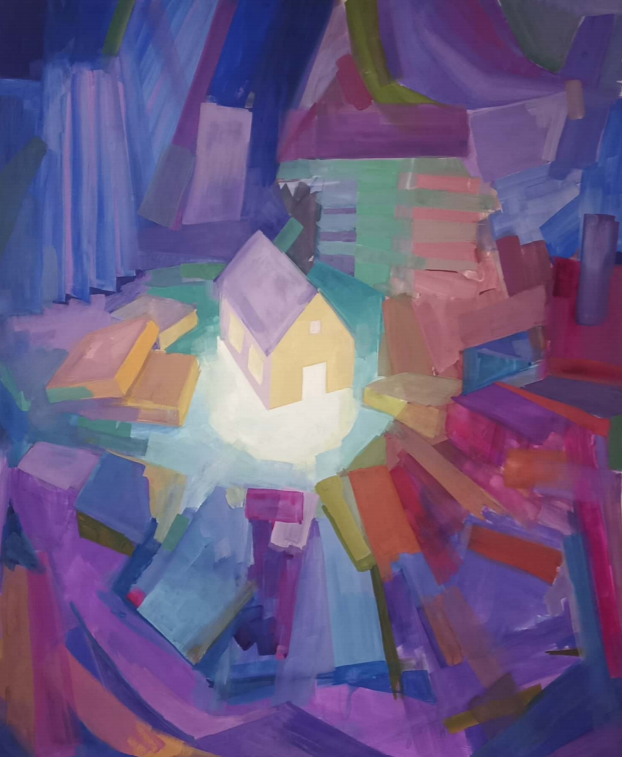
Formal Analysis: The art piece is of a house centered in the middle of a gathering of unspecified objects. The piece is paint on a paper background. All of the colors used to colored the unspecified objects are relatively cold, and are muted in intensity, featuring oranges, blues, blue-greens, and maroon reds. These colors are meant to make those surrounding areas unfriendly and foreign, seen as cold and uncomfortable, while the center of the page is colored with a warm glow of yellow and white-green, which creates an inviting and calming feeling. The use of shapes as the surrounding objects; unidentified and indistinct gives an unsettling tone, while the obvious silhouette of the house (which is a common object) is much more recognizable and comforting.
Content Analysis: This piece was meant to focus on the illusion of boundaries, and how those affect our perceptions of everyday life. In that, there is a very clear boundary around the house that can be deemed as “safe” while the other areas are rough and “unsafe”, creating the illusion of a boundary within the picture itself. However, these borders are not hard borders, as Flores also wanted to detail the permeability of these perceived boundaries. The gentle fade out of the warming lights recede into the outer boundaries, which in the fact that it doesn’t suddenly transition to a different color type, gives this sense of permeability. And it was on this permeability that Flores really wanted to commentate, especially it’s effect on a boundary’s ability to either contain or dis-silence those interacting by it.
Synthesis: The first thing that drew me to this piece was how peaceful it seemed, with vivid colors and an abstract concepts. The melding of the boundary between the clearing and what lies beyond, in my mind, echoes what human morality can be like. When one thinks of the word boundary, many people would think about a well defined object, that is black and white, much like I saw morality when I was younger. However, by displaying not only the colors of the two areas, but by displaying them in similar colors, I think Flores shows the evolution of the idea of morality as one ages, as those lines become unclear, and we can see that rather than black and white, morality is truly different shades of gray, unique for each person.
 Derek Zhang's Blog